04/26/2026
Prospects for a tough season
This year, farmers are facing exceptional pressure from high fertiliser prices which are at their highest level since Russia’s invasion of Ukraine in 2022. The World Bank forecasts the prices to rise in 2026 by 31%, before easing in 2027. Unfortunately, there is a risk that for late-season crops (maize, sugar beet and potatoes), another drought could exacerbate the difficult situation. Leading weather and climate modelling centres on both sides of the Atlantic – the ECMWF and NOAA, agree that an El Niño event is likely to occur between May and July 2026. There is also talk of the possibility of a ‘super El Niño’, similar to that of 2015. Taken together, these factors mean that optimising sowing and fertilisation this year could play an exceptionally important role in determining the profitability of the crop. Supporting such efforts is our mission.
Maize – last-minute ideas
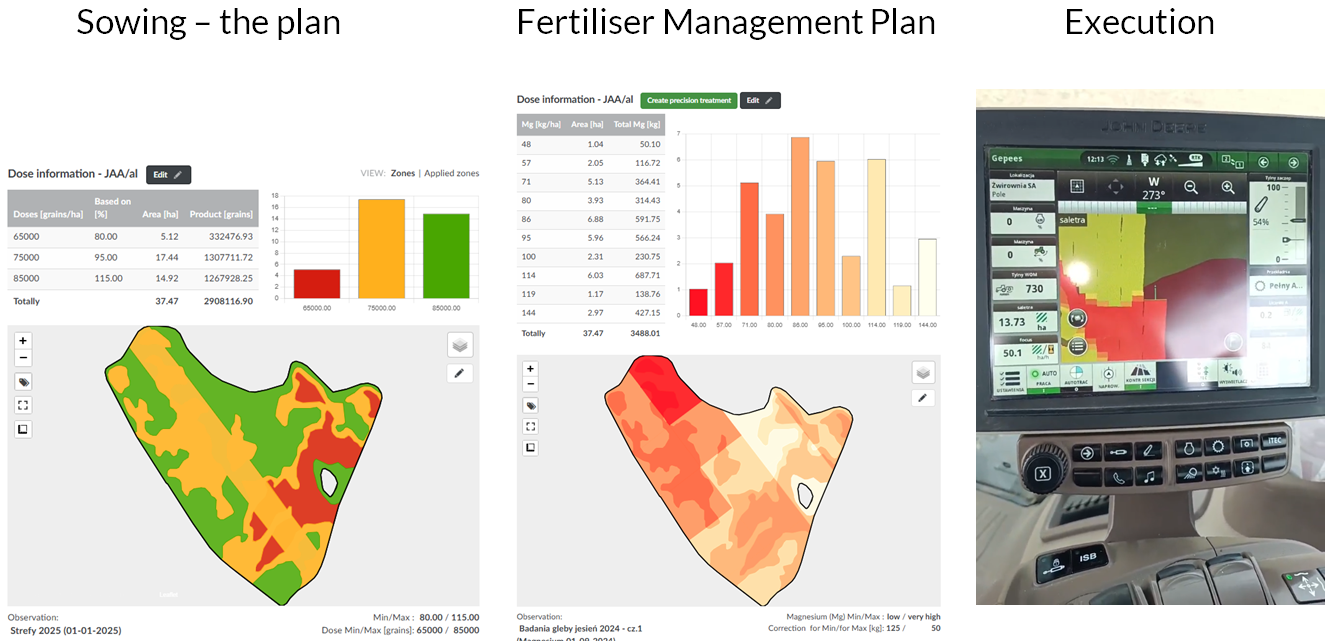
Admittedly, the weather is causing delays to maize sowing and the last application of fertiliser to cereals, but this is the very last moment to decide on adjusting planting densities and reducing fertiliser rates applied before or during the sowing of late-season crops. As water may once again be the main factor determining yield – or rather yield losses – it is essential that planting densities are lower on lighter soils and that inputs are not wasted there. Our advisors and analysts are currently helping to create management zones and application maps for fertiliser and seed application across hundreds of fields. At the same time, an increasing number of farms are operating independently, particularly in the second and subsequent seasons of collaboration. Our semi-automated fertiliser management plans in the form of maps are particularly appreciated. Furthermore, this season we are using new tools for manually editing application maps and designating control zones (see the example in the illustration below), which will allow us to verify the effects of precision sowing. A reduction of just 4–5% in seed rate per hectare is equivalent to the cost of a SatAgro subscription. Any other measure taken to optimise cultivation during the year will be pure financial benefit – from the differentiation of nitrogen and compound fertilisers, through crop-condition-based straw shortening, to soil testing that takes into account the actual pattern of the soil mosaic.
Wheat – let’s reduce the third dose where it makes sense
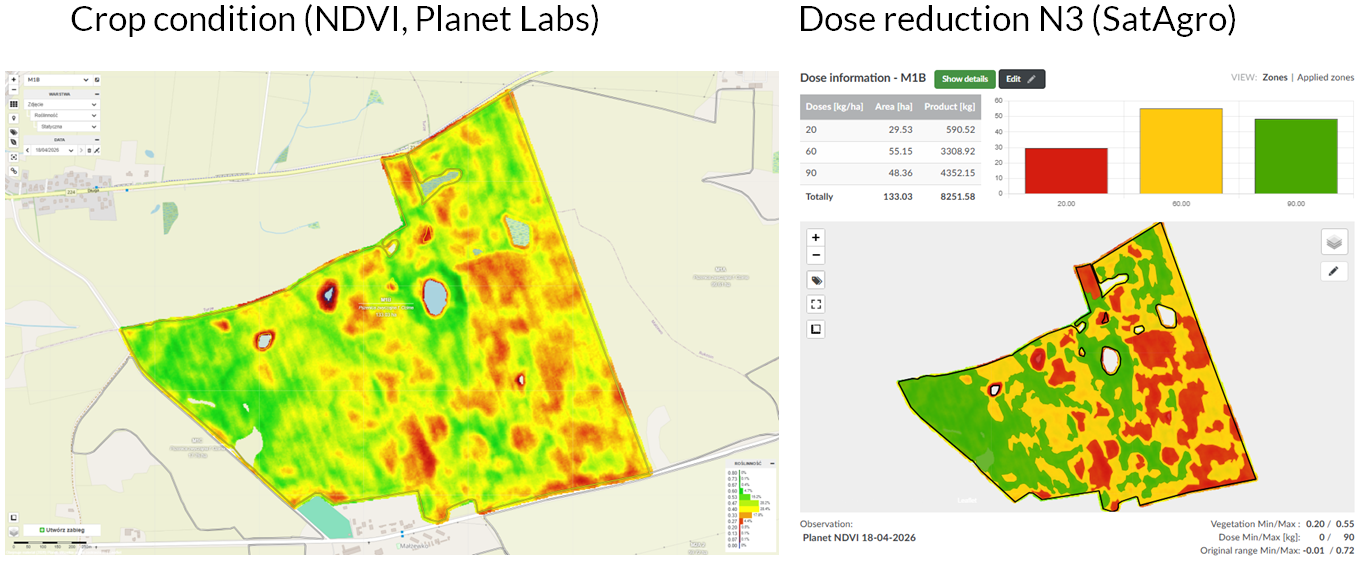
When it comes to applying fertiliser to wheat, the current weather conditions provide greater scope for reviewing dosing strategies. With the price of ammonium nitrate at around 2 000 zlotys per tonne, reducing the late-season dose by just 10% will fully recoup the investment in the SatAgro subscription, whilst also reducing the risk of lodging. For those interested, it is worth noting that this kind of optimisation immediately translates into a reduction in the crop’s carbon footprint by a few percentage points, as decreasing nitrogen fertiliser use is the most effective way to limit greenhouse gas emissions. All one needs to do is reduce the application rate on a canopy sections with poor prospects, which are clearly visible in current satellite imagery, including the high-resolution 3-metre images provided by our partner Planet Labs. In our region, an additional argument for reducing the dose is the fact that the relatively cold spring so far has slowed down the release of nitrogen from previous fertiliser applications. The example below illustrates a 30% saving on the third dose, with the crop with the highest potential receiving 100% and the one with the lowest potential – 20%.
We encourage anyone interested in working with us to get in touch and to monitor drought levels via the Water Deficit monitoring service which we are developing in collaboration with the Centre of New Technologies, University of Warsaw.
 Platforma